Unknown's avatar

Climate Change and Human Nature

(Sunday morning and the moon is New and I can’t sleep)

It’s always confused me why climate change is difficult for myself and others to really come to grips with, why we find it hard to change our living style in the face of reality. (Yes, the big question.)

A post at the blog Savage Minds this morning pointed me to an article by a writer named Lisa Bennett who recently wrote an article for the blog Grist in which she listed “10 things you want to know about human nature if you’re fighting climate change“. Wow, that title seemed to really imply it had the answers that I too was looking for, so I had to go read the full article (not just the extraction in Savage Minds). You can find the full article too by clicking here.

You really need to read what Lisa Bennett wrote to really understand the depth behind her 10 items. I have listed them here as teasers for you to follow.

1. We are overly optimistic about the future — our future, that is.
2. We can be blasé about the most important issues in the world because the global perspective is way beyond ordinary human scale.
3. We are wired to refute imperatives.
4. We are vulnerable to peer pressure, especially about things that confuse us.
5. We shy away from topics that remind us of our mortality but can be motivated to take action on behalf of beings more vulnerable than us.
6. We perceive and respond to risks only when we feel them.
7. We are motivated more by hope than fear, at least in matters of social change.
8. We are more likely to take action when we know precisely what we can influence.
9. We need to believe our actions will make a difference.
10. We will continue to behave the same way we always have — even after we know it is problematic — until there is a realistic alternative.

Again, read the full article: Lisa Bennett in Grist. It is worth our time.
Unknown's avatar

Windows Support Dates

Should Windows users take the plunge and move to Windows 10?  I can’t answer for you.  We are using Windows 7 in our house and are quite happy.  Of course, the new Surface 4 machines are sounding quite tempting, and perhaps when one of our laptops die, we could buy a Surface and then upgrade everything in the house!

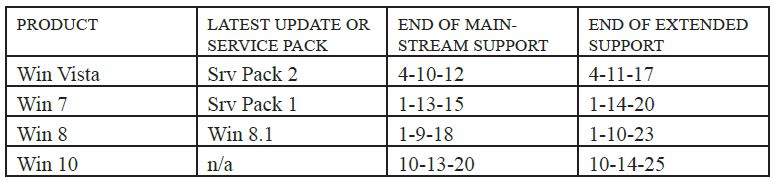
Meanwhile, there is support.  How long will Microsoft support our aging software?  That may be important to our decision making process.  The local computer user group MBUG just published a list of support dates.

winsupport

Windows 7 has 4 more years!  But, Windows 10 will only be a free upgrade until July 2016. Decisions, decisions…

Unknown's avatar

My Toolbar

Windows can have a confusing array of folders that can make it hard to find files when one is in a hurry; especially when you can’t remember the name of the file nor where it is located.  (I refuse to use the Desktop as a file storage folder!) When there are multiple users on a computer it can be even more difficult to locate files across other user’s folders.  Even though the folders in My Documents are well organized, I still misplace things.  Sure, I could search by name, but sometimes I forget what I named it!  I created this little set of shortcut folders to save me time.

Common Pointers

Create a folder directly in the C: drive called “My Toolbar”.  By putting this within the root of C:, it can be reached by all users on the machine.

Add this folder into the Taskbar of your computer.  That makes it easily accessible from anywhere.  See this picture of the right side of my own Taskbar.

Populate the folder with shortcut pointers to your most popular main programs or files.  I put sub-folders within the My Toolbar folder for groups of like software, such as MS Office programs.

For example, the folder “My Scans” points to the place that our sheet scanner puts the images it has scanner.  I added this pointer here because I was always forgetting where it is located!  The list of programs and folders can easily be reached simply by clicking into “My Toolbar” from the bottom of the screen in the Taskbar.

mytoolbar

Personal Pointers

The folder “My Toolbar” is common to all users of this machine. To get personal pointers per user, we build a second folder of pointers within the “My Documents” folder of each user called “Pointers”.  The icon named Pointers that look like a beach ball is a pointer to these unique folders, except that this link is customized to only point to the currently active user!

The properties of the Pointers icon contains this within the Target field:

“%userprofile%\My Documents\Pointers”

In this scenario, each user would populate their own private pointers within each their own “My Documents” folder.

By the way, the beach ball icon is found within the file:

%SystemRoot%\System32\pifmgr.dll.

The original pointer was a shortcut to a folder that I then modified the icon to stand out, to be easier to see quickly.

If, perhaps, you only want one “Pointers” folder for everyone to use (or if there is only one user on your machine), then you could easily put the folder into the Public Documents area:

C:\Users\Public\Documents\Pointers

Wrapup

Normally, I only include shortcuts within these folders. The actual files are scattered all over our computer in different folders.  Obviously, I can change the contents of this folder whenever I wish, as it is just full of shortcuts! The real files are well organized by category, subject, etc. elsewhere, as they should be!  These shortcuts are just for regularly used files, such as my health database, my checkbook Excel file, my cookie cleaner, etc..  You get the picture.  My Desktop is neat and tidy!

Unknown's avatar

Average human height

from the pages of Discover Magazine, October 2015,

The height of an average Dutchman has increased nearly 8 inches over the past 150 years. By comparison, the average American male’s height grew only about 2.5 inches over that same period. Dutch people are now, on average, the tallest in the world. Researchers credit all those inches to a number of factors, including heavy consumption of dairy products, universal health care and natural selection.

So I decided to check Google. The average world height of an adult male is 5 feet 6 inches, the average American white male is 5 ft 10 in.

Wikipedia shows the following by Country
Netherlands 6 ft
Norway, Sweden 5 ft 11.5 in
Denmark, Finland, 5 ft 11 in
Ireland, Russia 5 ft 10 in
Canada, U.S. 5 ft 9 in
China 5 ft 7 in
Cuba, Mexico, South Africa 5 ft 6 in (right on that average)
Vietnam 5 ft 5 in

The only gene so far attributed with normal height variation is HMGA2. Genetically speaking, the heights of mother and son and of father and daughter correlate, suggesting that a short mother will more likely bear a shorter son, and tall fathers will have tall daughters.

Today the tallest race of humans is the Nilotic peoples of Sudan such as the Dinka they have been described as the tallest in the world, with the males in some communities having average heights of 6 ft 3 in and females at 5 ft 11 in.

This doesn’t agree with the Discover Magazine exactly. According to Discover Magazine, 150 years ago, the Dutchman were 8 inches shorter, making them 5 ft 4 in. To grow 8 inches (12 %) on the average in only 150 years makes me wonder if perhaps immigration didn’t also have something to do with it.

Unknown's avatar

No Coal

Well hooray! The California legislature just passed a great law, which is expected to be signed by Governor Jerry Brown: SB185 requires the state’s two largest pension plans to divest their holdings in thermal coal as part of the push this legislative session has to address climate change.

“Coal is losing value quickly and investing in coal is a losing proposition for our retirees; it’s a nuisance to public health; and it’s inconsistent with our values as a state on the forefront of efforts to address global climate change,” the senate president pro tempore, Kevin de León, said in a statement. “California’s utilities are phasing out coal, and it’s time our pension funds did the same.”

See this article in The Guardian for a full write-up. no coal

Leave the coal in the hole!


Unknown's avatar

Trophy Hunting

A dentist was recently in the news for killing Cecil the lion in Zimbabwe. The problem is that this dentist isn’t the first and probably won’t be the last. Trophy killing seems to be in our nature.

A study published in Science 21 August 2015 titled “The unique ecology of human predators” suggest that

humans function as an unsustainable “super predator”, which – unless additionally constrained by managers – will continue to alter ecological and evolutionary processes globally.

We are the only known predator to regularly kill the largest of our prey, which, in the long run, is not sustainable. The largest are the breeding population — kill the parents and you kill their future offspring.

As Science Insights said about this study:

There are three key insights. First, the hunting of large prey is deeply embedded in our identity and remains a powerful ecological and evolutionary force. Second, the ability to target mostly adult individuals across marine and terrestrial prey groups makes us unique among all other predators. And third, we have the unusual ability to analyze and consciously adjust our behavior to minimize deleterious consequences. This final point, I believe, will prove critical for our continued coexistence with viable wildlife population on land and in the sea.

Do us all a favor. If you have a need to hunt, just hunt for food, and target only juveniles. Let the “big buck” go so he can continue to generate the species. No more trophies, no more bodies mounted on the walls. Our cave-man days should be in the past.

Unknown's avatar

Klotho Gene

More old news.

A recent discovery in the news is the Klotho gene which seems to boost brain function and adds to longevity. About one in five people have the good variant.

If you tested at 23andme, you can find out if you have it by checking the SNP at rs9536314, the protective variant is the heterozygous one, GT, while the normal variant is TT. The homozygous version, GG, appears to be deleterious.

So log into your 23andme account and then click this URL to see what variant you have. Or click this and then log in. https://www.23andme.com/you/explorer/snp/?snp_name=rs9536314

This link describes the basics.
http://blog.kittycooper.com/2014/05/klotho-a-gene-for-longevity-and-alzheimers-protection/

Naturally, I had to check with some of my friends to see who “got lucky”!

GT => Jim, Lori
TT => Barbara, Courtney, Debra, Jamie, Rachel, Sandra, Sandy,

I got a kick out of what Ray Kurzweil had to say: http://www.kurzweilai.net/anti-aging-gene-also-enhances-cognition

Unknown's avatar

Misophonia

The study of genetics is new.  Accordingly, saying that such and so disease or trait is “genetic” is still subject to much study and testing.  Sometimes being able to say whether you have wet or dry earwax (identified by SNP rs17822931) will be almost as much fun as sharing your astrological sign.   With much tongue-in-check, we checked some family members to see if they have risk factors for “misophonia”.  People who have misophonia are most commonly angered by specific sounds, such as slurping, throat-clearing, nail-clipping, chewing, drinking, etc..

According to a 23AndMe study the SNP rs2937573 is near the gene TENM2 and seems to be associated with misophonia among people of European ancestry. The SNP plays a role in brain development. The trait “sensitivity to the sound of other people eating” was found to correlate with allele values thusly: GG = higher odds, AG = average odds, and AA = lower odds.

In my family, the values seem to be opposite what they should be. Ah well, I am just the reporter…

GG => Jim, Debra, Jamie, Rachel
AA => Sandy, Courtney

Read more at this article.

BTW, I am not making funny of this science.  I really enjoy learning at the leading edge.  But I am a Sagittarius and enjoy having fun while being serious. 🙂

Unknown's avatar

First Peoples

PBS is starting a new series about prehistoric humans that will be starting June 24. I have already setup our DVR to record it. Around here it is on KQED-TV.

“See how the mixing of prehistoric human genes led the way for our species to survive and thrive around the globe. Archaeology, genetics and anthropology cast new light on 200,000 years of history, detailing how early humans became dominant.”

See more about it by clicking here

Unknown's avatar

The Papal Environmental Encyclical Is Online

On Care For Our Common Home

Today Pope Francis officially released his Encyclical that is concerned with the environment and how we are not taking care of the earth as requested.  The point of this post is to help you find a copy, not to argue the points.  Yes, I agree with most of what he has said, but we’ll leave that for another day.

All of the encyclicals are online.  They can be found here: www.papalencyclicals.net

This unique paper, I call it the “warning encyclical” can be located directly by clicking here

I pulled a PDF copy of the 184 page document from the above site (by clicking on the small PDF icon in the first page of the document) and emailed it to myself, and then opened it in my iPad which then allowed me to save it to my iBooks on the iPad so I can read it fully at my leisure. I also saved a copy here to make it easier for you to get a copy. Download the PDF by clicking here

Of course, I wouldn’t be me without tossing out a few zingers from the document:

43. Human beings too are creatures of this world, enjoying a right to life and happiness, and endowed with unique dignity. So we cannot fail to consider the effects on people’s lives of environmental deterioration, current models of development and the throwaway culture.

and

53. These situations have caused sister earth, along with all the abandoned of our world, to cry out, pleading that we take another course. Never have we so hurt and mistreated our common home as we have in the last two hundred years. Yet we are called to be instruments of God our Father, so that our planet might be what he desired when he created it and correspond with his plan for peace, beauty and fullness. The problem is that we still lack the culture needed to confront this crisis. We lack leadership capable of striking out on new paths and meeting the needs of the present with concern for all and without prejudice towards coming generations. The establishment of a legal framework which can set clear boundaries and ensure the protection of ecosystems has become indispensable; otherwise, the new power structures based on the techno-economic paradigm may overwhelm not only our politics but also freedom and justice.

Before you let the political pundits and the fossil fuel industry tell you what you should think about it, why not give it a chance and read it for yourself. A quick scan won’t hurt, and it might help us all.

Unknown's avatar

One Million at 23AndMe

23AndMe reached one million customers today 6/18/2015.  Just so you know, I was customer # 34,102, tested circa February 2010.  So there!  That is why my chip is # 2, and the data can’t be uploaded to gedmatch.  Oh well.  I did get to see my medical risk factors that were known at that time.

Unknown's avatar

Monterey Chapter of Climate Change Lobby meets March 31

Last month, the first meeting of a newly formed Monterey chapter of the Citizen’s Climate Lobby (CCL) was held in Monterey, CA.. The first meeting was just to get the ball rolling, to find out if there was enough interest to move forward, etc. It was a success with over 30 people attending.

Citizens’ Climate Lobby is a nonprofit, non-partisan, grassroots advocacy organization focused on national policies to address climate change. Carbon Fee and Dividend is the policy proposal created by Citizens Climate Lobby to internalize the costs of burning carbon-based fuels.

CCL provides a path through which ordinary citizens who want to do more to solve the climate problem than just clicking online petitions can become involved. The group doesn’t require any special skills, just a desire to try and help grease the wheels for climate policy in the USA and Canada.

If you weren’t able to attend our inaugural meeting and are still interested in joining our chapter, please plan to attend our first chapter meeting on Tuesday March 31 at 6:00 pm at the Monterey Bay Aquarium in the Guide Lounge.

The Guide Lounge is across the street from the Aquarium in the building next to the drop-off area for tour buses, on the first floor beyond the front desk. Someone will be there to let you in. Feel free to bring something to eat and drink. Hope you can join us.

For more information about CCL in general, go here: citizensclimatelobby.org

I enjoyed this post by Carla Wise in “High Country News” about her CCL chapter:
www.hcn.org/articles/climate-change-activism-needs-anybody

CCL

Unknown's avatar

Megadrought?

These quotes below are from an article found at Science Advances – 01 Feb 2015, a new journal of the AAAS American Association for the Advancement of Science.

You can also listen to a talk given on NPR’s Science Friday 13 Feb 2015 about this study, with Jason Smerdon, one of the authors. Click here => Science Friday – 13 Feb 2015

There is ≥80% chance of a multidecadal drought during 2050–2099 in the Central Plains and in the Southwest United States. … Ultimately, the consistency of our results suggests an exceptionally high risk of a megadrought occurring over the Central Plains and Southwest regions during the late 21st century.

We have demonstrated that the mean state of drought in the late 21st century over the Central Plains and Southwest will likely exceed even the most severe megadrought periods of the Medieval era in both high and moderate future emissions scenarios, representing an unprecedented fundamental climate shift with respect to the last millennium.

Our results point to a remarkably drier future that falls far outside the contemporary experience of natural and human systems in Western North America, conditions that may present a substantial challenge to adaptation. ….. And, perhaps most importantly for adaptation, recent years have witnessed the widespread depletion of nonrenewable groundwater reservoirs, resources that have allowed people to mitigate the impacts of naturally occurring droughts. In some cases, these losses have even exceeded the capacity of Lake Mead and Lake Powell, the two major surface reservoirs in the region. Combined with the likelihood of a much drier future and increased demand, the loss of groundwater and higher temperatures will likely exacerbate the impacts of future droughts, presenting a major adaptation challenge for managing ecological and anthropogenic water needs in the region.

Do listen to the NPR podcast linked above. It isn’t as technical as reading the article.

Huge water shortages are coming. The probability of a huge megadrought goes above 80%! Should we move? These are personal questions. On-the-ground stake holders have serious question to ask. It is going to become more expensive to live in California! The rains of the AT&T Pro AM may indeed be a thing of the past.

The problem with moving away from these areas is that, as more and more of these studies come out, people all around us will begin to move. This drought is going to be with us no matter what we do. Planning where to move that will give one a “good life” will become more and more difficult. Northern California or perhaps SW Canada is looking more and more inviting! We don’t need to rush, sometime in the next 15 years would be good. We just need to be ahead of the collapsing land values. 🙂

Unknown's avatar

Start Research On Climate Engineering

From Nature Magazine – 5 Feb 2015

Climate engineering — cooling Earth intentionally by modifying its radiation balance — worries many people. We know little about the effectiveness of these technologies or their side effects. The unintended consequences could be profound.

As the consequences of climate change become starker, public calls for interventions may grow. Governments or companies may try climate engineering to reduce the severe impacts predicted by 2050.

The article recommends that government agencies and scientists should begin climate-engineering research now.  You can read the full article through the above link. The line that woke me up is “public calls for interventions may grow.”  My grandkids will be part of the “public” in 2050.

I finally see how this climate change issue may play out.  The fossil fuels lobbies will continue to use mass mind control to obfuscate the issues (disinformation) until the weather itself convinces the populace that something must be done.  It will be too late to stop major catastrophes, and we will want to “engineer” our way out of the mess.  Finally, the public calls for interventions will grow.  

We need to help our Congress understand that we should act now so we don’t have to wait for the above scenario to happen.


Fossil fuels lobby” is the umbrella term used to name the paid representatives of large fossil fuel (oil, gas, coal) and electric utilities corporations who attempt to influence governmental policy. So-called Big Oil companies such as ExxonMobil, Royal Dutch Shell, BP, Total S.A., Koch Industries, Chevron Corporation, and ConocoPhillips are amongst the largest corporations associated with the energy lobby. General Electric, Southern Co., First Energy, and the Edison Electric Institute are among the influential electric utilities corporations. Both electric companies and big oil and gas companies are consistently among the ten highest-spending industrial lobbyists.

Unknown's avatar

Weather Words

Global Warming” refers to an increase in the average temperature near the Earth’s surface.

Climate Change” refers to the broader set of changes that go along with global warming, including changes in weather patterns, the oceans, ice and snow, and ecosystems; both caused by homo sapiens causing rising levels of greenhouse gases.

Anthropocene” epoch refers to the Age of Man, relating to or denoting the current geological age, viewed as the period during which human activity has been been the dominant influence on climate and the environment.

Unknown's avatar

The World is getting hotter

This post is serving 2 purposes: First purpose is to display a link to a graphic created by Bloomberg that shows how the average yearly temperatures have been increasing during the last 135 years.  See here

http://www.bloomberg.com/graphics/2014-hottest-year-on-record/

Bloomberg Hottest Year

Second purpose is to test this system to see how adding links works!  (grin)

Reminder to self: just pasting the link doesn’t cut it (like the first one above). To force it to open in a new tab, you need to use html and add target=blank.