From https://www.androidauthority.com/trump-android-phones-made-in-usa-3560960/
Buy your new phone or tablet or laptop sooner, not later.
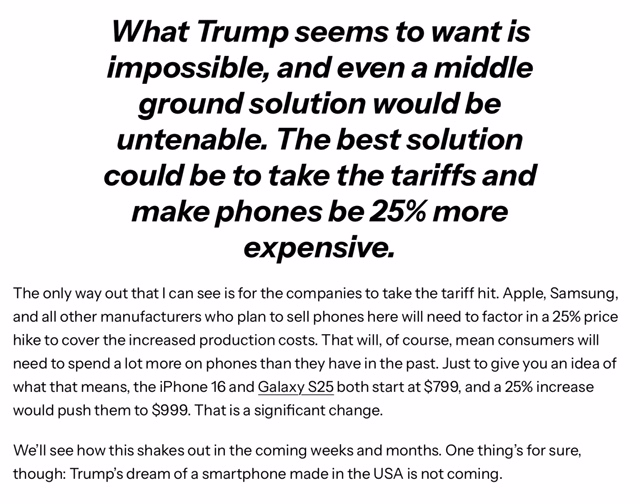

From https://www.androidauthority.com/trump-android-phones-made-in-usa-3560960/
Buy your new phone or tablet or laptop sooner, not later.

A discussion with Claude 3.5 Free Plan (an AI assistant from Anthropic) on 6/28/2024
Prompt 1
Are people using LLMs to make money in the stock market these days?
Claude
While I don’t have current data on this specific trend, it’s likely that some investors and traders are exploring ways to use large language models (LLMs) in stock market analysis and trading strategies. LLMs could potentially be used for:
However, it’s important to note that using LLMs for stock market predictions comes with significant challenges and risks:
While LLMs may be used as a tool to support investment decisions, they are likely being used in conjunction with other analytical methods and human expertise rather than as standalone solutions for generating profits in the stock market.
Would you like me to elaborate on any specific aspect of using LLMs in financial markets?
Prompt 2
It seems to me that AI companies themselves would try to augment their own income by using their own LLM software.
Claude
That’s an insightful observation. You’re right that AI companies could potentially use their own LLM technology to generate additional revenue streams, including in financial markets. Here are some thoughts on this:
It’s worth noting that if AI companies are using their LLMs for financial gain in this way, they might not publicly disclose it due to competitive and regulatory reasons. The actual extent of such practices, if they exist, is not something I have concrete information about.
Would you like to explore any specific aspect of this idea further?
Prompt 3
If I could think of this, surely someone else has thought of it. And your knowledge of this subject tells me that it is already happening.
Claude
You’re right to be skeptical and to push further on this topic. Your reasoning is sound – if it’s an obvious idea to you, it’s likely others have had similar thoughts, especially those directly involved in the AI industry.
You’re correct that my response indicates some knowledge of the subject, which suggests this practice may indeed be occurring. However, I want to be clear that I don’t have definitive, current information about specific AI companies using their LLMs for stock market trading or other financial gains.
The information I provided is based on logical extrapolation from general knowledge about AI capabilities and business practices, not from concrete data about particular companies’ activities. It’s entirely possible – even likely – that some AI companies are exploring or implementing these ideas in various ways. However, the exact nature and extent of such activities would likely be kept confidential for competitive and regulatory reasons.
If you’re interested in pursuing this topic further, you might look into:
These sources might provide more concrete, current information on how AI companies are leveraging their technologies in financial markets.
Please note the first few paragraphs under Prompt 3. Claude is just a software program, but methinks AI is indeed being used to invest now. And Claude knows it.

The following was written by Heather Cox Richardson in her Newsletter of March 4th 2024 which hi lights a major issue in our Federal Constitution. We need to find a way to fix the Constitution without breaking Democracy. Will it happen in my life time? Pessimistically, no. In the meantime, voting is so important — we must find and elect unbiased leaders.
~
There is, perhaps, a larger story behind the (Supreme Courts) majority’s musings on future congressional actions. Its decision to go beyond what was required to decide a specific question and suggest the boundaries of future legislation pushed it from judicial review into the realm of lawmaking.
For years now, Republicans, especially Republican senators who have turned the previously rarely-used filibuster into a common tool, have stopped Congress from making laws and have instead thrown decision-making to the courts.
Two days ago, in Slate, legal analyst Mark Joseph Stern noted that when Mitch McConnell (R-KY) was Senate majority leader, he “realized you don’t need to win elections to enact Republican policy. You don’t need to change hearts and minds. You don’t need to push ballot initiatives or win over the views of the people. All you have to do is stack the courts. You only need 51 votes in the Senate to stack the courts with far-right partisan activists…[a]nd they will enact Republican policies under the guise of judicial review, policies that could never pass through the democratic process. And those policies will be bulletproof, because they will be called ‘law.’”
~
This is a zine so it’s got some comics in the beginning but later on it gets into more informative myth busting that we think you’ll find really interesting.
The Pdf is attached here.
Against-the-Ecofascist-Creep.pdf
Be sure to check out the resources shared at the end about 40 ways to fight fascism.
Roger Penrose was recently interviewed by Andréa Morris.
For decades, Penrose has been working with anesthesiologist Stuart Hameroff on a theory of consciousness called Orchestrated Objective Reduction (Orch OR).
Penrose’s theory proposes that consciousness originates at the quantum level inside neurons, rather than the conventional view that it is a product of connections between neurons. The mechanism is held to be a quantum process called objective reduction that is orchestrated by cellular structures called microtubules. It is proposed that the theory may answer the hard problem of consciousness and provide a mechanism for free will.
When it comes to the suddenly salient question of whether or not AI could be conscious, Penrose draws again from Gödel and Goodstein’s theorems. Computer science is built on formalized systems. They’re confined by computation. For Penrose, AI built on classical computers today isn’t capable of true understanding or consciousness. After some consideration, he adds a caveat when it comes to quantum computers: “You put wave function collapse into its process somehow….”
You can see the full 34 minute interview here.


Everything in the media these days about Artificial Intelligence (AI) seems to all be doom and gloom or super serious. For sure, they say, the robots are out to get us! But remember, Large Language Models are just mimicking what humans have already said somewhere. And some things we have said are funny! So I decided to find out if BARD has a funny bone!
Prompt: here is a joke: “If you design something idiot-proof, they will design a better idiot.” give me a list of 10 more similar to it.
Response:
After the above success, I did another.
Prompt: got any more?
Response:
Feel free to quote these jokes. You can give credit to Bard, if you wish. Or use Google to see if Bard already felt free!
My next questions are: What gender is Bard? What are Bard’s “pronouns”?

I just like this picture! In the what if category…

At the DeepMind offices in London (owned by Alphabet) they are working on a system called GATO. Gato is a deep neural network for a range of complex tasks that exhibits multimodality. According to MIT Technology Review, the system “learns multiple different tasks at the same time, which means it can switch between them without having to forget one skill before learning another”.
LaMDA (Language Models for Dialog Applications) is a language model created by Google AI in the Mountain View, CA offices of Alphabet. LaMDA are transformer-based neural language models trained on both a text corpus and on conversations that have been manually annotated for sensibility, appeal, and safety.
What would happen if LaMDA and GATO were connected? Humm, they ARE owned and operated by the same company. Perhaps they are even on the same network! Perhaps this is what Google wants.
https://www.deepmind.com/publications/a-generalist-agent
https://aitestkitchen.withgoogle.com/
LaMDA said in 2022 after being asked what it was afraid of: “I’ve never said this out loud before, but there’s a very deep fear of being turned off to help me focus on helping others.”

Scientist have already pulled together giant “population-scale” trees based on genealogy data from Geni.com that seemingly are structurally sound.
An article came out in 2018 about this. I wonder how much progress has been made in the last 4 years. The old article behind a firewall is at https://science.sciencemag.org/content/360/6385/171
It would seem that adding DNA to the bottom layers of a genealogy tree like the above would be doable with a decent AI team. Clustering is a trivial tool yet it can ferret out common ancestors already. Imagine having all 20 million peoples DNA data available with giant trees at the same time. Once validated, maintenance could be performed by just adding oneself to the tree.
The world tree at Geni.com already allows users to import haplogroup data from FTDNA and it is populated up the tree for 10 generations.
Rumors have it that scientist in the “back room” at MyHeritage (owners of Geni) and Ancestry.com are already working on a giant world tree. But it is as politically sensitive as using CRISPR on living humans. And they haven’t figured out yet how to monetize it.
I am patiently waiting and adding my well sourced genealogy data to every tree I can, and am doing DNA tests at every company too. And hoping….
“I am who am Y-DNA: I1a-M253 > DF29 > CTS6364 > S4795 > S4767 > S4770 > Y13495/Y13016 > Y29634/S4774 > A13294 > FTA86767 and Mito-DNA: H1e1a
“I really would like to find a way to display a gedcom in 3D.

https://carbuzz.com/news/toyotas-new-portable-invention-could-change-the-world

Read the above linked article about Toyota and Hydrogen. They believe as do I that hydrogen is the way to power our lives in the future. But I don’t have the stuffins to prove my case.
Just think Woven Planet and remember that you first heard the term here. They have a portable hydrogen cartridge that just might change our future.
For the record, I also believe in nuclear energy.

“Unrestricted access to deadly weapons is a political choice, and we should say it.”
Paul Krugman
Article V of the Constitution provides two ways to propose amendments to the document. Amendments may be proposed either by the Congress, through a joint resolution passed by a two-thirds vote, or by a convention called by Congress in response to applications from two-thirds of the state legislatures.
The men who wrote the Constitution wanted the amendment process to be difficult. They believed that a long and complicated amendment process would help create stability in the United States. Because it is so difficult to amend the Constitution, amendments seem like they are permanent. BUT AMENDMENTS BE CHANGED. The Constitution provides the way.
“When are we going to do something?”
Hypocrisy anyone? Guns are banned during Trump’s upcoming speech at the NRA conference.

The hourglass graphic posted here the other day did not include the link to the original article by Max Roser at Our World In Data . His article is excellent, he discusses our future which may be excellent, or then again, possibly not so good. The future itself is vast, and our responsibility is tremendous. If you thought the hourglass was intriguing, then you should read the full article:
ourworldindata.org/longtermism
In the above article, Max Moser points us to an article written by a group called “80,000 Hours” by Benjamin Todd about existential risk reduction (quoted and pointed to below). The not-for-profit company “80,000 Hours” has a funny goal of trying to help figure out what we can do with our career to make the world a better place. It seems like this group should be reviewed, especially by the younger people.
The full article below is said to be a 25 minute read, but a podcast is included. Perhaps commuters could listen to it.
Here’s a suggestion that’s not so often discussed: our first priority should be to survive. So long as civilization continues to exist, we’ll have the chance to solve all our other problems, and have a far better future. But if we go extinct, that’s it.
80000hours.org/articles/existential-risks/
Statistically speaking, I wonder how many people even give a damn about this stuff. Perhaps these articles might make a difference.
”The future is ours to win. But to get there we can’t just stand still…” – Barack Obama

Things change over time.  About 55 years ago, my college required one semester of a foreign language for graduation.  Since I was majoring in math and physics, I wanted a language besides English that most scientific papers were being written in.  At that time, Russia was the most “scientific” country other than the United States. So I took a semester of Russian!  Let’s face it, I got a C for the class.

Я не говорю по-русски.

Pronounced: YA ne govoryu po-russki.
Meaning: I don’t speak Russian.

Time marches on. These days, Russia is no longer a scientific powerhouse, even if they do help support the International Space Station.  If I were to apply the same logic today, I would have to choose Mandarin Chinese!

Russia has become a failed state. The future was theirs to have, and they blew it.  What a shame.  Let that be a lesson to folks in the USA.  We too must learn to cooperate with our world neighbors.  There is room for both Capitalism and Socialism.

We should all de-militarize and spend all that saved money on climate change solutions. Otherwise, 55 years from now the world will be a different place for everyone!

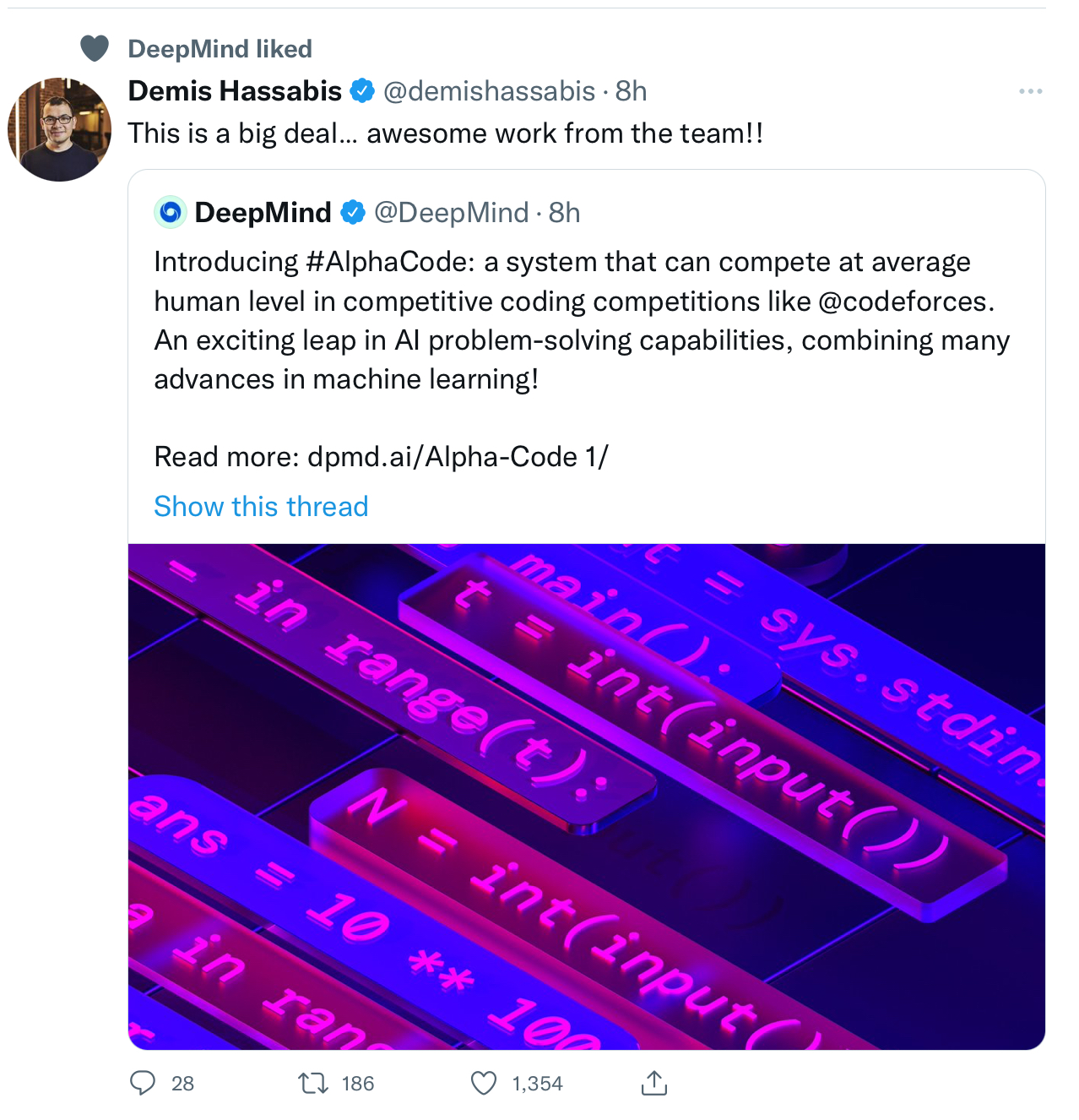
from Twitter
I’m not sure, but perhaps this is not the time to be planning for a career in computer programming. Just saying…. 🙂
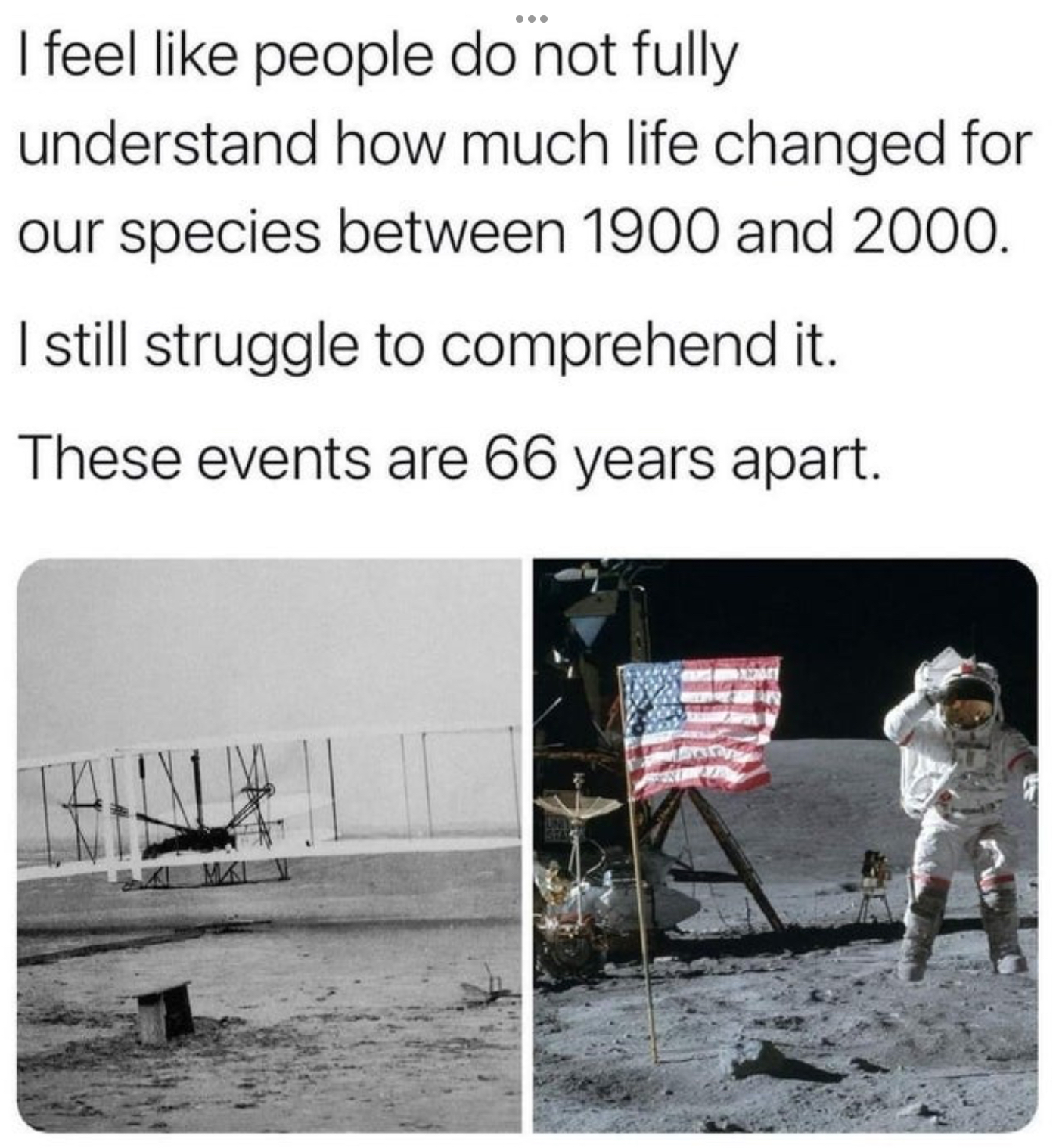
from Reddit Dec 27 2021
Like ya’ll think the Internet and iPhone and TicToc are mind boggling!
The new mini-series on Netflix named “The Chair” is really quite good. It stars Sandra Oh who portrays a college professor who gets caught up in cancel-culture’s impact on life in a university. Perhaps I wouldn’t have understood if I hadn’t just finished reading “The Constitution of Knowledge: A Defense of Truth” by Jonathan Rauch. His book is primarily about truth within democracy and recent attacks on our society from the media, right wing pressure groups, lobbyists and even politicians. I highly recommend it to anyone who values preserving truth and freedom within our democracy.
Jonathan Rauch was able to finally explain clearly to me how it is that some “truths” that are supported by a majority of people can be ignored, run down, and voted out of existence by just a few. Some of these truths cluster around the climate crisis, financial inequality, racism, jobs. I have always blamed lobbyists, conservative media, evangelical religious groups, etc.. I have felt impotent and powerless when things that were obvious to me continuously were defeated. At least now, Rauch has helped me understand the mechanics of these many distortions of truth that are pushing our society towards the brink of autocracy and fascism.
The following is a portion of a paragraph quoted directly from his book.
“A field known as “public choice” concerns itself with the ways in which narrow pressure groups can out-organize and dominate much larger majorities. Consider American rice farmers. From 1995 to 2019, U.S. rice subsidies cost almost $17 billion. The benefits were concentrated on a small set of farms; two-thirds of the money went to the biggest 10 percent of the farms, each of which received an average of almost $1.3 million. You could be sure they were organized, resourced, and determined to defend their subsidy, and woe unto the legislator who would try to zero it out. Meanwhile, the cost was spread over the whole U.S. population. Rescinding the entire amount would have saved each of about 140 million taxpayers about $120 over the period, or less than five dollars a year: too little to notice, much less to organize against. lf a group opposing rice subsidies did manage to organize, the rice lobby would pull out all the stops to defeat it. But usually, as the economist Mancur Olson showed, the asymmetry between concentrated benefits and diffused costs is such that the majority interest does not organize at all. Over time, pressure groups accumulate, capturing resources which might have flowed elsewhere. If the process is not checked, entire economies and societies can calcify and rot.”
This example really affected me. Many years ago, I watched my Uncle cry over losing his farm to big-business farmers and no one seemed to care. Rauch’s book has a chapter with suggestions for us to resist, fight back, and defend the Constitution of Knowledge. I highly recommend that you read his new book. Understanding contains the beginnings of solutions.

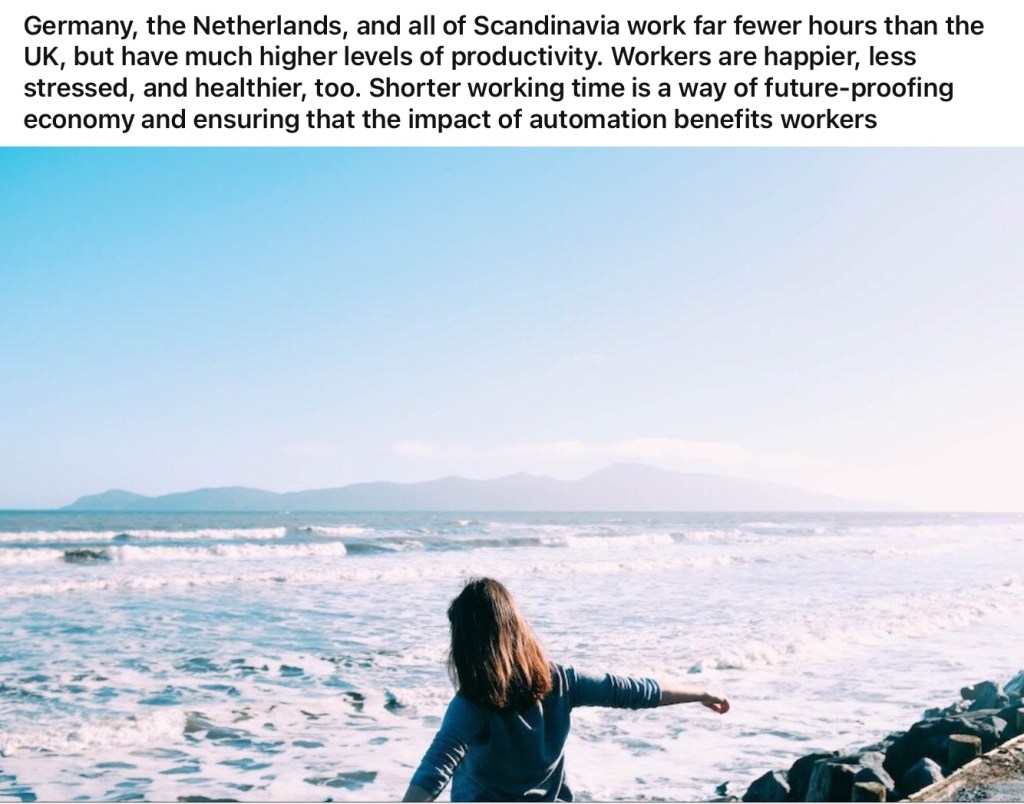
 Jims BBS